Yellow-Legged Asian Hornet (Vespa velutina)
The Yellow-Legged Asian Hornet (also referred to as the Yellow-Legged Hornet or Asian Hornet) is a highly aggressive predator of insects. It poses a grave risk to honey bees and other pollinators as it kills large numbers to provide its larvae with protein. A single nest of Yellow-Legged Asian Hornets can consume over 11kg of insects in a season.
Yellow-Legged Asian Hornets are established in much of Europe, including France and Jersey, and a number of sightings and nests have been found in the UK since 2016. To date it is believed that all these have been destroyed and the UK is pursuing a policy of ongoing eradication. Therefore, it is important that we stay on the alert and report any sightings to the National Bee Unit. The general public and beekeepers are being asked to participate in this Yellow-Legged Asian Hornet watch.
How to identify the Yellow-Legged Asian Hornet (YLAH)
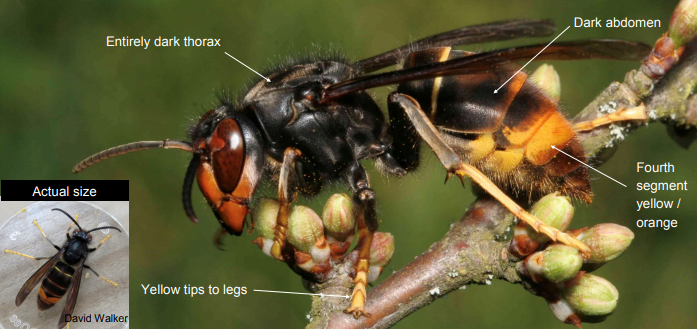
The YLAH is about 25-30mm (1 inch) long and has a dark brown or black velvety body and a dark black/brown abdomen apart from the fourth segment which is yellow/orange. It has an orange face and distinctive legs with yellow ends – hence its name. They are never active at night.
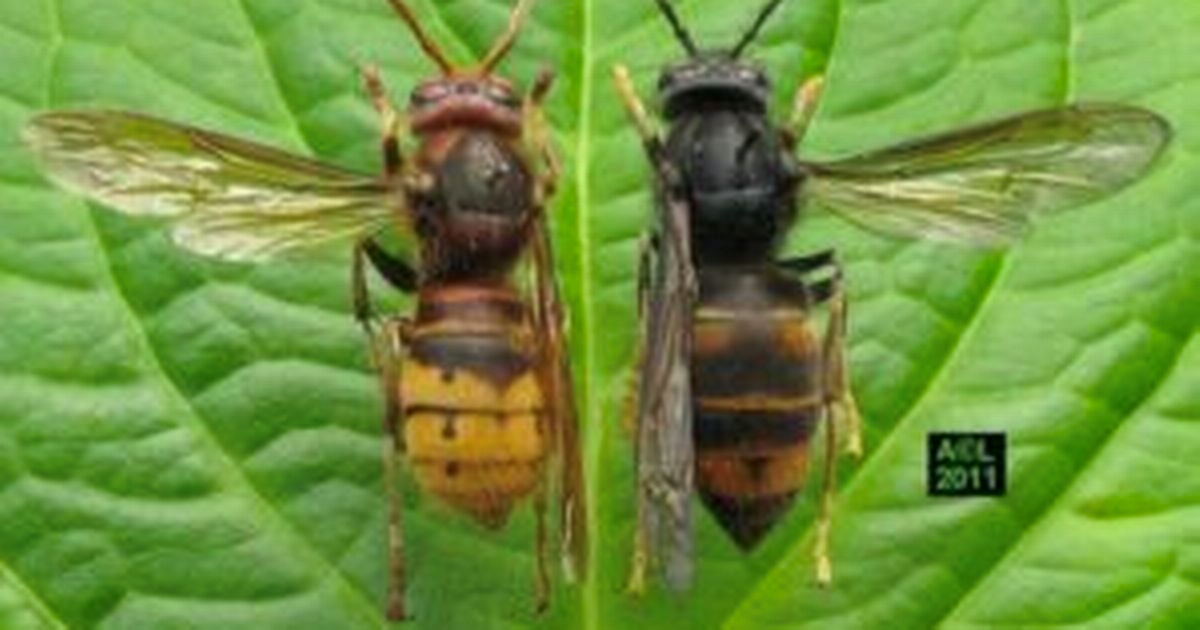
The YLAH can be confused with the native European Hornet which does not pose a threat to bees and should NOT be harmed.
The European Hornet is larger than the YLAH at about 35mm (1.5 inches) in length. It has a red/brown/bronze body, yellow head and antennae and more yellow abdominal segments than the YLAH. It has red/brown (not yellow) legs and may be active at night.
Native European Hornet

Native Hornet (Left), Asian Hornet (Right)
European Wasp
A close relative of the native hornet is the European (common) Wasp which is smaller, at about 20mm (0.8 inch) in length, and has distinctive black and yellow markings, compared with the brown and yellow makings of the native hornet. Although these can be a nuisance to humans and honey bees they should not be reported.
How to report sightings of YLAH:
If you see a YLAH, do not try and find the nest. The YLAH does sting and it is important NOT to disturb an active nest. Report your sighting using one of the following methods:
- Asian Hornet Watch app for iphone, download free from App Store
- Asian Hornet Watch app for Android, download free from Google Play
- By email at: alertnonnative@ceh.ac.uk
Reported sightings should be accompanied by a photograph if possible to reduce the number of false alarms.
It is an offence to release a live YLAH, so if you have caught one in a trap, keep it alive if possible and report it as outlined above.
Need help in identifying the YLAH?
It is important that we do not overwhelm the National Bee Unit with false alarms. If you need help in identifying a species you think is a Yellow-Legged Asian Hornet then contact your local Beekeepers’ Association Yellow-Legged Asian Hornet Action Team. You can find details at https://www.bbka.org.uk/asian-hornet-action-team-map
More information
The British Bee Keepers Association (BBKA) web site provides extensive information about YLAH and how to report sightings. There are links to articles and videos covering the experience with YLAH in France. https://www.bbka.org.uk/Listing/Category/asian-hornet-vespa-velutina

 Ludlow & District Beekeepers Association